Hong Kong Corals & the Associated Marine Life
|
Hong Kong Corals & the Associated Marine Life
Phylum Echinoderata Phylum Echinodermata consists of five classes of marine organisms which are widely distributed in benthic habitats from intertidal zone to deep sea. Echinoderms display a bilateral symmetry in larval stage and a radial symmetry in adult stage. They possess an internal skeleton of calcium carbonate plates (called ossicles) and a water vascular system, which are unique to them. Some 450 echinoderms are found in waters of southern China. Of these, around 140 species have been recorded from Hong Kong down to depths of 30m. It contains both the tropical and sub-tropical echinoderm species found along the mainland coast.
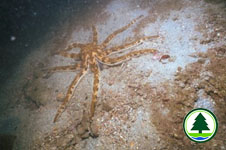
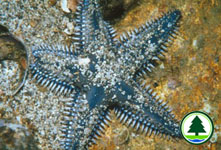
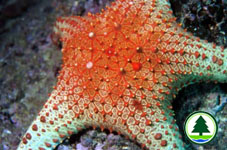
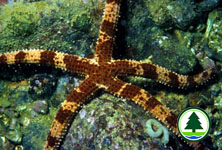
Starfish have the most obvious pentagonal symmetry among echinoderms. Although most of them have five arms, the number and length of arms can vary among species. The body actually consists of five equal segments, each containing a duplicate set of various internal organs. The mouth is located in the middle of the bottom side while the anus is on the top. Most starfish are predators and their diet is variable, ranging from enriched film on rocks to sponges and bivalves. The most notorious starfish is Crown-of-thorns which feeds on coral polyps and destroys huge amount of corals. Starfish are well known for their power of regeneration. A complete new animal can grow from a body fragment. It is reported that killing the Starfish, e.g., Crown-of-thorns, by chopping it into pieces cannot control its number, but increase the population in multiples. Some 28 species of starfish are known from Hong Kong, approximately one quarter of the 78 species known from southern China.
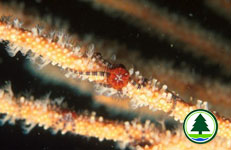
Brittle stars typically have only five arms with a discrete central disk. They are close relatives of starfish, but differ in several respects. There is no replication of internal organs, just a single set in the central disk. The mouth is situated in the centre of the underside of the disk, but with no separate anus. Although they possess a typical echinoderm water vascular system, they use it only for feeding, but not for locomotion. Generally, brittle stars are detritus feeders or predators of small organisms. They use slimy mucus to trap microorganisms and detritus. Most of the brittle stars are cryptic, hiding among rocks and crevices during the day and emerging at night.
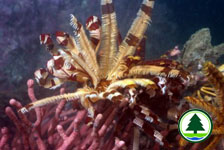
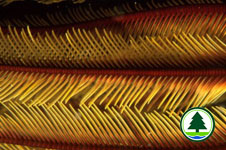
Feather stars (or crinoids) are the oldest echinoderm and are often referred to as "living fossils". They are filter feeders and therefore especially abundant in areas exposed to periodic strong currents, where there are an abundant supply of planktonic food. Feather stars have an oral disk in the centre of the body, with anus above and mouth underneath. Same as brittle stars, there is only a single set of internal organ in the disk. On the underside of the body, special appendages (cirri) for clinging and crawling can be found. The number of arms radiated from the oral disk is variable depending on the species and even individual. Some have only five while others have up to 200, but mostly 10 to 20 arms. Individual arms have numerous, fine, side branches (pinnules) and therefore feathery in appearance. The pinnules are coated with sticky substances that aid in catching food. Fifteen feather stars have been identified from local waters while 62 species are known from southern China. They are mostly found on rock areas below 10m depth.
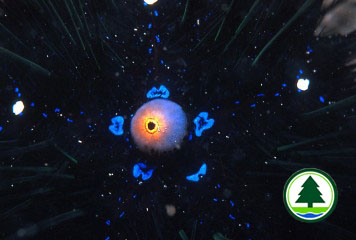
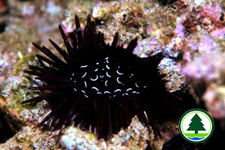
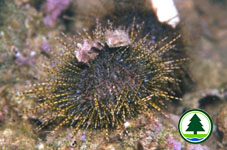
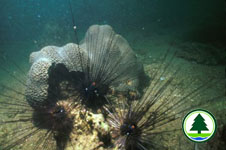
The most distinct feature of sea urchin is the spiny chitinous skeleton. The protective spines may contain venom that causes a severe burning sensation. Many species of sea urchin are algal grazers, but some feed on a variety of encrusting organisms, such as sponges, bryozoans and ascidians. Their mouth is centrally located on the underside of the body. It is equipped with well-developed jaws and a set of horny teeth. The anal opening is situated in the middle of the upper surface where there may be a spherical and semi-transparent cloaca protruded out. Tube feet of sea urchins are relatively long and used for locomotion, respiration, excretion of waste, chemical reception and digging.
Some 27 species of sea urchin are found in Hong Kong while a further 64 species have been recorded from Southern China. Some sea urchins, such as the Diadema urchins exist in abundance, possibly because their natural predators such as triggerfish and large wrasses are scarce in local waters.
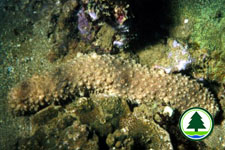
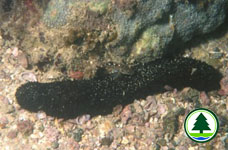
Unlike other members of this Phylum, sea cucumbers do not display a distinct radial symmetry. They have an elongated body, with the lower surface modified with abundant tube feet for attachment or creeping. Most sea cucumbers are deposit or detritus feeders. Those having some of their oral tube feet modified to branching tentacles are filter feeders. Sea cucumbers are capable of exuding sticky and distasteful white tubules (cuvierian tubules) from their anus if being threatened. A related but more violent defensive mechanism is evisceration, in which internal organs are expelled through the ruptured body to entangle and distract the enemy. In both cases, they are able to regenerate the lost structures and survive. In southern China, 101 species of sea cucumber are recorded but only 30 species are found in Hong Kong.
|
||||||||||||||||||||||||||||||||||||||||||||||||||||||||||||||||||||||||||||
 |
||||||||||||||||||||||||||||||||||||||||||||||||||||||||||||||||||||||||||||
|
||||||||||||||||||||||||||||||||||||||||||||||||||||||||||||||||||||||||||||
|