The objectives of the branch are:
- To provide financial and technical support to fishermen and fish farmers for promoting the sustainable development of the fisheries industry;
- To enforce legislation to regulate the fisheries industry;
- To plan and implement suitable projects and measures for the conservation and management of fisheries resources; and
- To provide administrative support to the Fish Marketing Organisation (FMO).
|
 |
The fisheries industry, which comprises capture fisheries, mariculture and pond fish culture, provides a steady supply of fresh fish to the local market. In 2009, the capture fisheries and mariculture sectors accounted for about 30% of all seafood consumed in Hong Kong, whereas pond fish farms produced about 4% of the total consumption of freshwater fish.
Capture Fisheries
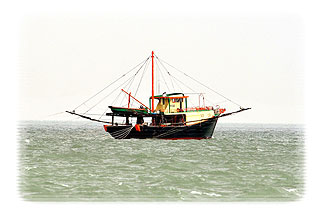
In 2009, the number of fishing vessels was about 3,700 and that of local fishermen was about 7,600. The main fishing methods are trawling, long-lining, hand-lining, gill-netting and purse-seining, with about 83% of the total catch obtained through trawling. The number of fishing vessels by type is at Appendix 4. In 2009, the industry produced an estimated 159,000 tonnes of fisheries produces, of which about 54,000 tonnes were consumed in Hong Kong.
Mariculture
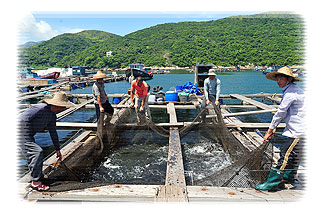
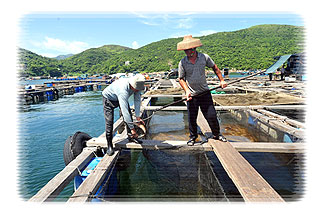
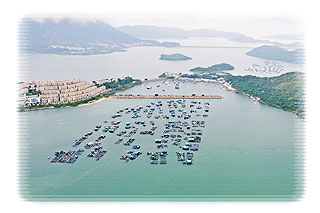
Mariculture involves rearing marine fish in cages suspended by floating rafts in sheltered coastal areas. In 2009, there were about 1,040 licensed operators in the 26 fish culture zones designated under the Marine Fish Culture Ordinance (Cap 353) (a location map is at Appendix 5), occupying a sea area of 209 hectares. Most licensed operations are small and family-based, with farm size averaging about 280 square metres. Estimated production in 2009 was 1,437 tonnes, or about 9% of all locally consumed live marine fish.
Pond Fish Culture
Most inland ponds are located in the Northwest New Territories. These ponds, covering some 1,120 hectares, produced 2,105 tonnes of freshwater fish in 2009. Most ponds practise polyculture of carps mixed with tilapia or grey mullet. Some coastal ponds have been converted to culture brackish species, such as scat, sea bream, pampano and giant grouper, to reap better profits.
The Department has implemented various measures to promote the sustainable development of the fisheries industry.
Combating Destructive Fishing Practices
Hong Kong waters are patrolled regularly to deter destructive fishing practices prohibited under the Fisheries Protection Ordinance (Cap 171). These practices include the use of explosives, toxic substances, dredging or suction devices and apparatus that transmits electricity. Nine cases of illegal fishing were successfully prosecuted in 2009.
Artificial Reefs Deployment
Artificial reefs are effective in promoting the growth and development of various marine organisms which in turn provide food, protection and shelter for fish. Since 1996 the Department has been implementing an artificial reefs programme and some 179,000 cubic metres of artificial reefs have been deployed at suitable locations including Marine Parks, and important fish spawning and nursery grounds in Port Shelter and Long Harbour. Over 220 species of fish, including many high-value ones such as grouper, bream, snapper and sweetlip, have been found using the reefs for feeding and shelter, as well as spawning and nursery. To improve the water quality and seabed condition of fish culture zones, artificial reefs used as biofilters were deployed in the Kau Sai, Sham Wan and Lo Tik Wan fish culture zones.
Support Services
The Department provides technical support, training and liaison services, and credit facilities to fishermen. During the year, the Department continued to liaise with both Mainland and foreign fisheries authorities and agencies to obtain information on recreational fishing, aquaculture, fish processing and other sustainable fisheries operations, and disseminate it to fishermen. Technical advice was also given to fishermen to help formulate their development proposals.
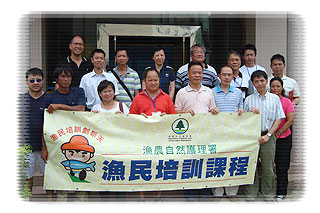
To help some 1,200 fishing vessels affected by the annual two-and-a-half-month fishing moratorium in the South China Sea implemented by the Mainland authorities in 2009, fishing moratorium and extra loans were made available to the affected vessels' owners under the Fish Marketing Organisation Loan Fund. Some 500 fishing moratorium loans and some 320 extra loans totaling $76.3 million were issued to affected fishermen in 2009. Vocational training courses and seminars were also organised for fishermen to raise their awareness of fisheries management and conservation, and to upgrade their knowledge and skills in fisheries related operations.
Fisheries Impact Assessment
To protect fisheries resources and habitats, the Department continued to vet and provide professional advice on development proposals as well as relevant Environmental Impact Assessment studies, monitoring and auditing programmes to ensure that the potential impacts of development projects on fisheries would be adequately addressed, evaluated and minimised through effective mitigation. The Department also assisted in conducting investigations in fish kills or water quality deterioration incidents allegedly caused by development projects with a view to providing prompt advice on remedial actions and minimising fish loss.
Proper Management of Marine Fish Culture Activities
Under the Marine Fish Culture Ordinance (Cap 353), all marine fish culture activities in Hong Kong are required to be operated under licence in designated fish culture zones. The Department conducts regular patrols in these fish culture zones to ensure that fish culture activities comply with the Ordinance and the licence conditions.
To meet the public demand for recreational fishing facilities and to help mariculturists diversify their business, the Department has implemented a scheme to allow mariculturists to operate recreational fishing business on licensed fish culture rafts. As at March 2010, 38 licensees in 9 fish culture zones have been given the permission to conduct such business.
Safeguarding Aquaculture Environment
To minimise the impact of red tides and water quality deterioration on mariculture, the Department regularly monitors water quality of fish culture zones and implements a red tide monitoring and management programme. The latter includes proactive phytoplankton monitoring before the formation of a red tide and rapid risk assessment of reported red tide incidents. A computerised system using Geographic Information System technology was established to help visualise the spatial and temporal distribution of red tides and provide a quick analysis of their development and movement. Prompt red tide warnings and technical advice are disseminated to mariculturists and the public through the red tide support groups set up in various fish culture zones, press releases and the Red Tide website (www.hkredtide.org).
Sixteen red tide incidents were recorded in Hong Kong waters in 2009. No associated fish kills were reported from these incidents.
Promoting Good Aquaculture Practices
To help fish farmers minimise losses due to fish disease, the Department has put in place a fish health inspection programme. During the year, regular farm visits were conducted to facilitate early detection of disease outbreaks, training was provided to fish farmers on disease prevention measures, and fish disease diagnosis and treatment services were given in case of an outbreak. Under the "Good Aquaculture Practices Programme", the Department visits fish farms regularly to collect water and fish samples for analysis to monitor conditions of the farms. Seminars, on-farm demonstrations and advisory booklets are given to farmers on new techniques and good management practices.
Accredited Fish Farm Scheme
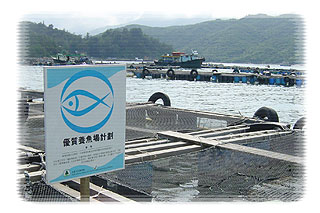
A voluntary Accredited Fish Farm Scheme has been implemented since mid 2005 to enhance the competitiveness of the local aquaculture industry. Participating fish farms are required to adopt a set of good aquaculture practices with a view to raising the environmental hygiene standards of the fish farms and the quality of cultured fish. Quality assurance tests, including analyses of drug residues and heavy metals in fish, are conducted to ensure that all cultured fish meet food safety standards before they are sold in the market. The scheme has been very well received by local mariculturists and pond fish farmers. As at March 2010, a total of 88 fish farms (27 fish ponds and 61 mariculture farms), representing 17% of the total area of local fish farms, have registered under the scheme. In collaboration with the FMO, the Department continued to publicise and promote the marketing of fish products under this brand name.
Culture Trials of New Fish Species
To provide a wider choice of species for culture, the Department proactively identifies new species with good market potential that can be recommended to farmers. Following the successful completion of culture trials on jade perch (Scortum barcoo), the Department assisted fish farmers to conduct trials on the hatching of fertilised eggs and rearing of fish fry, and induced spawning of jade perch with a view to helping them secure a stable supply of fish fry at a lower cost. Jade perch, originated from Queensland, Australia, is a good candidate for pond fish culture. It is of high nutritional value, with an especially high percentage of poly-unsaturated fatty acids. Jade perch has been marketed as an accredited produce under the Accredited Fish Farm Scheme and well received by the public.
Voluntary Registration of Local Aquaculture Farms
To promote the quality of local aquaculture farms, the Department implements a voluntary registration scheme for local pond fish farms. As at March 2010, 276 pond fish farmers have registered under the scheme.
Promoting Development of Local Fish Hatchery
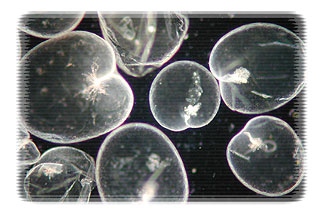
The Department has been conducting fish hatchery trials in Ta Kwu Ling since 2008. A training workshop on large-scale production of live feed for grouper larvae was organised jointly with the Daya Bay Fisheries Development Centre in September 2009 to help local farmers acquire knowledge and techniques of live feed production and grouper larval rearing.
Committee on Sustainable Fisheries
A Committee on Sustainable Fisheries was set up in December 2006 to study the long term goals and directions as well as feasible options and implementation strategy for the sustainable development of the fisheries industry, with regard to fisheries trends, ecological sustainability, economic viability and other relevant factors, such as financial implications and social impact. The Department chaired and provided supporting services to the Committee. The Committee conducted a thorough review of the issues pertaining to local fisheries, and explored various possible measures that might contribute to the sustainable development of the fisheries industry and conservation of marine resources in Hong Kong.
Ensuring Orderly Wholesale Marketing
The Department provides technical and administrative support to the FMO, a statutory organisation established under the Marine Fish (Marketing) Ordinance (Cap 291) to ensure that orderly fish marketing services are provided to fishermen and fish traders through the wholesale fish markets operated by the FMO. The Department also undertakes enforcement actions against illegal wholesale marketing of marine fish in accordance with Cap 291.
Promotion of Local Fisheries Products
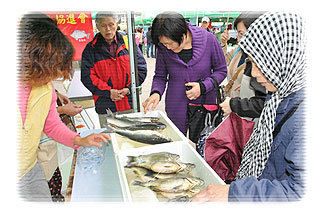
The Department works closely with the FMO to promote local fisheries products. During the year, the FMO continued to develop quality fisheries products at its processing centre and to bring local fisheries products, in particular fish accredited under the Accredited Fish Farm Scheme, to the public through its marketing network.
|