Introduction
-
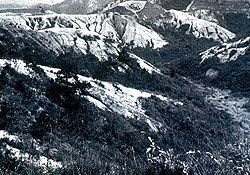
After centuries of cutting and burning, some of the Hong Kong hillsides gave an overall impression of dry barren soil.
- Only vegetation in some steep ravines and the Fung Shui woods behind villages in the New Territories remain largely intact.
- Afforestation has been carried out in Hong Kong as early as 1870s. The major purposes for this has shifted from amenity reasons, erosion control, production of firewood, improving water supplies and to the current interest in biodiversity enhancement and ecological restoration.
|
| |
| Back to Top |
Choice of species
-
Early afforestation effort was concentrated on the use of the local pine, Pinus massoniana and fast growing exotic species such as Lophostemon confertus and Acacia confusa.
- Native species have been used more often in the last 30 years.
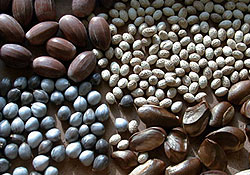
- To date, seeds of over 100 native species have been collected to produce seedlings for afforestation.
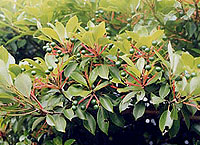
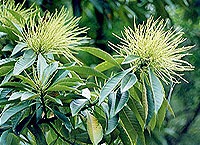
- Some of the successful examples of native species used for afforestation are Machilus species,Castanopsis fissa and Schima superba.
 |
|
Machilus species
|
|
 |
|
Castanopsis fissa
|
|
| |
|
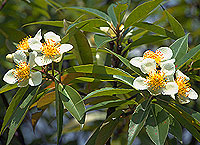 |
| Schima superba |
|
|
| Back to Top |
Field Investigation
|
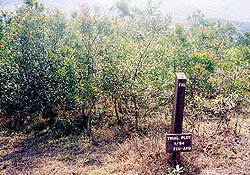
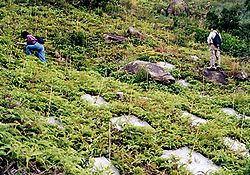
Trial plots have been set up and subsequent monitoring carried out to assess the growth performance of various species in different environment and effectiveness of a range of tree establishment techniques. |
| |
|
Methods to improve seedling establishment including the use of weed mat and tree guard are now in experimental stage. |
|